Maples
The scientific name for maples is Acer, a word of Latin origin. The word Acer derives from the Proto-Indo-European word ac, meaning "sharp, to be sharp, to sharpen" and seems to represent the sound of sharpness. The word's association with the genus Acer possibly comes from the pointed leaves associated with maples. Another definition for Acer is to mean "split or be split," from the shape of the leaves. Furthermore, Acer derives from acris, meaning "hard" because of the hardness of maple wood.
In English, it is described as maple, in german, ahorn, and in French, erable.
In Japan, the word momiji and kaede are synonymous with maples. The word kaede derives from kaerude in the "Manyoshu." You can tell by the shape of the leaves that it is similar to those of a "frog's hand." The Japanese word for "frog" is pronounced "kaeru" and "hand" is pronounced "te," and "de" was changed from "te."
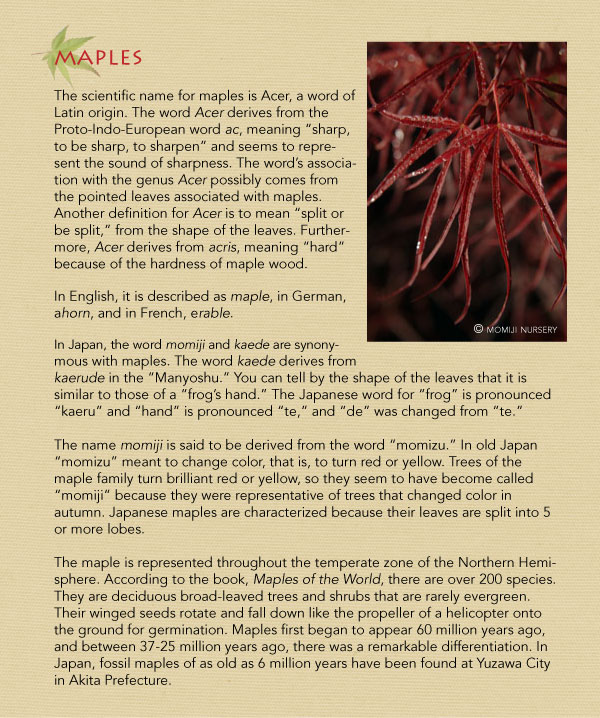
The name momiji is said to be derived form the word "momizu." In old Japan "momizu" meant to change color, that is, to turn red or yellow. Trees of the maple family turn brilliant red or yellow, so they seem to have become called "momiji" because they were representative of trees that changed color in Autumn. Japanese maples are characterized because their leaves are split into 5 or more lobes. Most North American maples have 3 lobes.
The maple is represented throughout the temperate zone of the Northern Hemisphere. According to the book, "Maples of the World," there are over 200 species. They are deciduous broad-leaved trees and shrubs that are rarely evergreen. Their winged seeds rotate and fall down like the propellor of a helicopter onto the ground for germination. Maples first began to appear 60 millions years ago, and between 37-25 million years ago, there was a remarkable differentiation. In Japan, fossil maples of as old as 6 million years old have been found at Yuzawa city in Akita Prefecture.
|